A Career Clarity Course
You’ve been faced with a challenge. You don’t have to have it figured out to start.
Layoffs, burnout, and careers that stop fitting are more common than anyone admits — and more disorienting than most people expect. That’s not a personal failing. It’s a human response to a difficult situation. However you got here, you’re carrying more than you’re being given credit for — including by yourself.
What helps is a clear process, the right support, and an honest look at what you still have to offer — which is more than you think.
This course gives you all three. Twelve sessions. A real coach. An AI companion designed to personalize every step. And a path that leads somewhere worth going.
You don’t need to feel ready. You just need to begin.
Enroll today — and take the first honest step toward what’s next.
10–12 Session Course • One-on-One Coaching
From Stuck to Purposeful
A confidence and career clarity course for adults navigating transitions — with an AI coaching companion for every session.
Course Contents
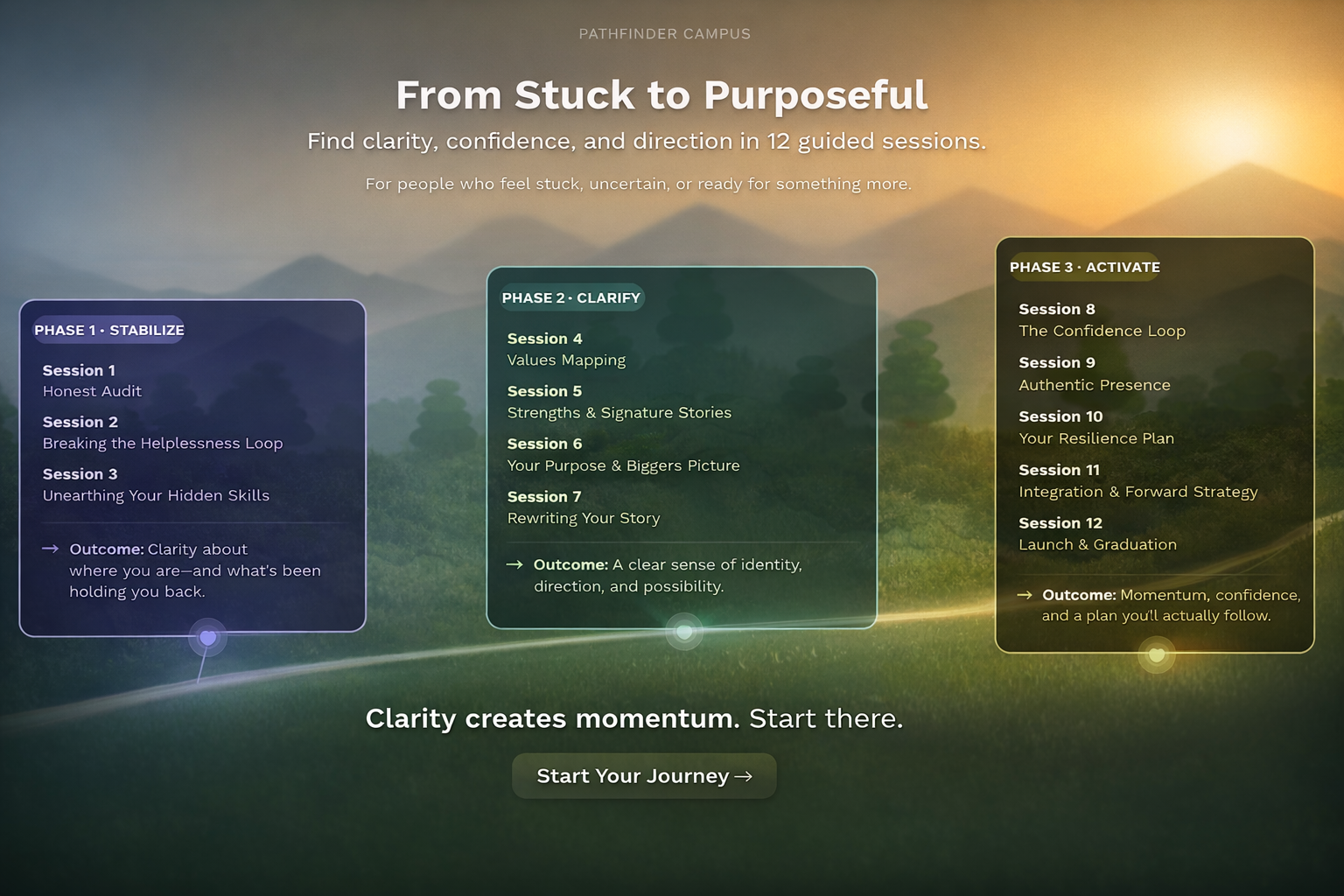
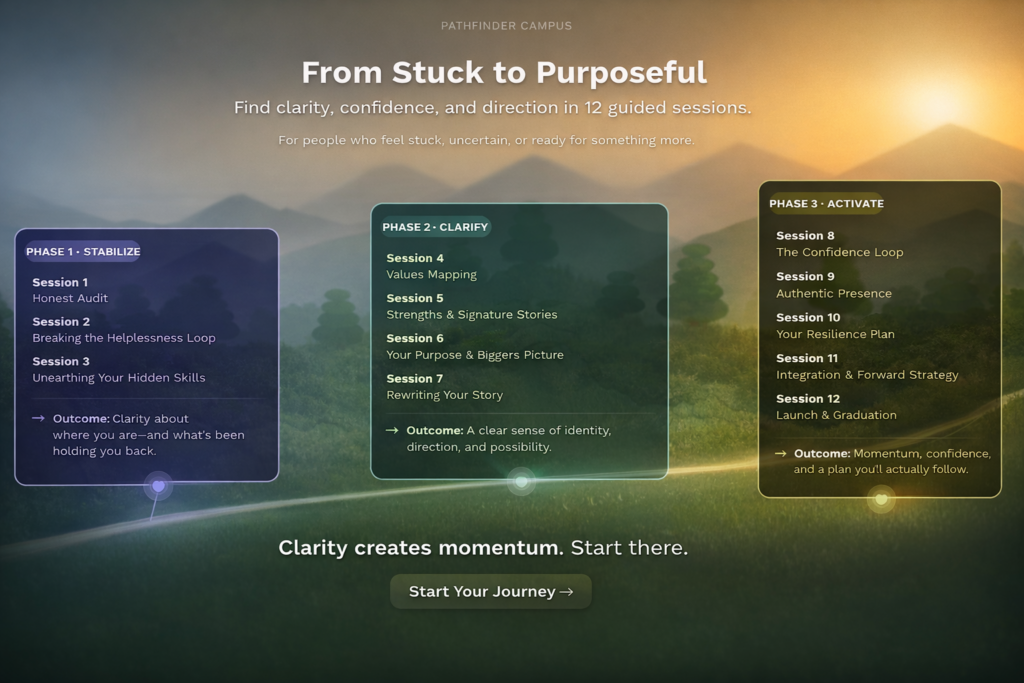
Session 1 — The Honest Audit Session 2 — Understanding Learned Helplessness Session 3 — The Skills Excavation Session 4 — Values Mapping Session 5 — Strengths & Signature Stories Session 6 — Purpose & The Bigger Picture Session 7 — Narrative Reframe Session 8 — The Confidence Loop Session 9 — Authentic Presence Session 10 — Resilience & Relapse Prevention Session 11 — Integration & Forward Planning Session 12 — Launch & Graduation
Building Your Personal Profile
Run this prompt once before Session 1. The profile you create will personalize every AI conversation that follows.
What is a Personal Profile and why does it matter?
Every session prompt in this course works well on its own. But when the AI knows who you are — your background, your communication style, what you’re working through, and how you think — every response becomes significantly more relevant and personal.
Your Personal Profile is a short, structured block of text that you create once and reuse throughout the course. It takes about 10–15 minutes to build. At the end, the AI gives you a formatted profile you can save and use in two ways:
Method A — Set it once in your AI account (recommended)
Paste your profile into your AI tool’s permanent settings so it applies to every conversation automatically. In Claude: Settings → Custom Instructions. In ChatGPT: Settings → Personalization → Custom Instructions.
Method B — Paste it at the top of each session prompt
Copy your profile and paste it before the session prompt text, then add the line: Please keep this profile in mind throughout our entire conversation.
After completing your profile, share it with your coach so you’re both working from the same picture of you.
Try It With AI
Personal Profile Builder
A guided conversation that helps you build a reusable profile — covering your background, communication style, thinking patterns, and course goals — so every AI session feels personal, not generic.
Session 1
The Honest Audit
Getting an accurate, compassionate picture of where you actually are right now — without judgment and without spin.
Most people who arrive at a coaching program have been carrying a story about themselves for months, sometimes years. It’s usually a story of failure, stagnation, or disappointment — and it’s usually only partially true. Before anything else can shift, you need a clear-eyed, honest picture of your actual situation: what’s really happening, what you’ve tried, and where the genuine obstacles are.
This session is not about solving anything yet. It’s about creating the conditions for good work: a foundation of trust between you and your coach, and an honest account of where you are that separates the facts of your situation from the interpretations you’ve layered on top of them. That distinction — between what actually happened and what you’ve decided it means about you — is often where the most important work begins.
What you’ll explore in this session
- A clear account of your current situation — professionally and personally
- What you’ve already tried, and what hasn’t worked
- Where you feel most stuck, and where you have more room than you think
- The internal story you’ve been telling yourself — and where it may be inaccurate
- The difference between circumstances and self-concept
Before This Session — Think About
- If you had to describe where you are right now in one paragraph — just the facts — what would you say?
- What have you tried in the past six to twelve months that hasn’t worked out as you hoped?
- What is the story you most often tell yourself about why things haven’t changed?
- Is there any area where you feel quietly optimistic, even if you haven’t admitted it?
Key ideas for this session
Facts vs. narrative. “I applied for 40 jobs and got no responses” is a fact. “I’m unemployable” is a narrative. This session helps you see which is which — and start treating facts as information rather than verdicts.
Clarity before change. It’s tempting to skip straight to solutions. This session resists that. The more honest and specific your picture of the present, the more effective every subsequent session will be.
Honesty is an act of courage. Especially when things haven’t gone the way you hoped, being honest requires real bravery. Your coach’s job in this session is to make that safe.
Try It With AI — Between Sessions
The Honest Audit Coach
A guided conversation that helps you separate the facts of your situation from the story you’ve built around them — so you can see where you actually are with clarity and compassion.
Session 2
Understanding Learned Helplessness
Naming the pattern that has been holding you back — and beginning to separate it from your identity.
When people face repeated setbacks — rejected applications, stalled careers, roles that never felt right — something predictable begins to happen in the mind. Effort starts to feel pointless. Taking action starts to feel risky. The brain, trying to protect us from more disappointment, quietly begins to conclude that outcomes are outside our control. This state has a name: learned helplessness.
Understanding that this is a psychological pattern — not a character flaw, not evidence of who you are — is often one of the most liberating moments in this course. Learned helplessness is a response to circumstances. It developed for a good reason. And crucially, it is reversible. This session is about naming it clearly, understanding how it shows up in your specific life, and beginning to separate it from your sense of self.
What you’ll explore in this session
- What learned helplessness is and how it develops — in plain language
- How it shows up for you specifically: in your job search, your daily habits, your self-talk
- The difference between “I can’t do this” and “I’ve been in conditions that made success feel impossible”
- Areas of your life where you still have agency — even if you’ve stopped noticing them
- The beginning of separating this pattern from your identity
Before This Session — Think About
- Where have you stopped trying — not because you couldn’t, but because it didn’t feel worth it?
- Are there areas where you hold back effort to protect yourself from disappointment?
- Can you think of a time recently when something went better than you expected — that you haven’t given yourself much credit for?
- What would you attempt if you were genuinely certain it would work?
Key ideas for this session
Learned helplessness is reversible. It was learned in response to real circumstances. That means it can also be unlearned — with the right conditions and the right evidence.
Naming it removes much of its power. Once you can see the pattern clearly — “that’s learned helplessness talking, not truth” — you create a small but significant gap between the pattern and your response to it.
You’ve had more agency than you’ve been counting. This session will surface areas of your life where you have had impact and control — that you’ve been dismissing or forgetting. These become the seed of something more important in later sessions.
Try It With AI — Between Sessions
Learned Helplessness Awareness Tool
A grounding conversation that helps you understand the learned helplessness pattern, identify where it shows up in your life, and find concrete examples of agency you’ve been overlooking.
Session 3
The Skills Excavation
Uncovering the full breadth of your transferable skills — including the ones you’ve stopped counting.
Most people who have been through a difficult job search or an unsatisfying career start to shrink their sense of what they’re capable of. The skills that don’t appear on a job posting start to feel irrelevant. The abilities you’ve developed in caregiving, community work, side projects, or earlier life chapters get quietly dropped from the inventory. By the time someone arrives at this course, they often have a drastically underestimated picture of what they bring.
This session works through stories — not job titles or resume bullets. Stories are where skills actually live. When you describe a problem you solved, a situation you navigated, or a moment when someone counted on you, the real portfolio of your capabilities becomes visible. By the end of this session, you’ll have a Skills Inventory that is broader, richer, and more evidenced than anything on your current resume.
What you’ll explore in this session
- A story-based inventory of your transferable skills from any area of your life
- Skills you’ve been underselling or forgetting entirely
- The difference between skills you have and skills you enjoy — a distinction that matters enormously for career direction
- How others tend to see your capabilities before you do
- The beginning of an evidence file: real, specific proof of your competence
Before This Session — Bring 2–3 Stories
- A time you solved a problem — from any context (work, home, volunteering, community)
- A time someone came to you for help and you delivered
- A situation that was difficult or uncertain, and how you navigated it
- Something you built, organized, created, or improved — even informally
Key ideas for this session
Transferable skills live in stories. A resume lists job titles. A story reveals what you actually did — what you figured out, who you influenced, what would have gone wrong without you. Stories are far richer than bullet points.
Non-paid experience counts fully. Caregiving, volunteering, managing a household, running a community group — these develop real, sophisticated, marketable skills. This session gives them the weight they deserve.
The skills you enjoy are not always the ones you lead with. You may be excellent at something that drains you. Part of this session is distinguishing between skills you have and skills that energize you — which is essential information for choosing a direction.
Try It With AI — Between Sessions
Skills Excavation Interview
Bring two or three real stories from your life and let this AI coach draw out the transferable skills underneath — organizing them into a full Skills Inventory with evidence you can actually use.
Session 4
Values Mapping
Discovering what you actually care about — not what you think you should care about.
One of the most common reasons people end up in a career that doesn’t fit is that they chose it based on external signals — salary, status, what their family expected, what seemed practical — rather than their own values. Values are the conditions that make work feel meaningful and sustainable. When they’re present, you feel energized even on hard days. When they’re missing, no amount of success can compensate.
This session is about identifying your real values — not the impressive-sounding ones, but the ones that actually show up in your choices and your body. You don’t figure out your values by writing a list of admirable words. You find them by looking at the moments when work has felt deeply right — and the moments when it has felt hollow — and asking: what was present or absent?
What you’ll explore in this session
- The difference between values you perform and values that actually drive you
- What your best and worst work experiences reveal about what you need
- Your top four or five core values — with practical definitions for each
- Which values you’ve been compromising, and what that has cost you
- Values as a decision filter for evaluating future opportunities
Before This Session — Think About
- Describe a time when work (or any meaningful activity) felt deeply right. What was present?
- Describe a time when work felt draining, wrong, or like you were going through the motions. What was missing?
- What do you find yourself envying in other people’s careers? (Envy is often a values signal.)
- What would you refuse to compromise on in your next role, even if offered more money?
Key ideas for this session
Values appear in your choices, not your descriptions. What you say you value and what your decisions reveal you value are often different. This session closes that gap.
Vague values are useless values. “Making a difference” is too broad to help you decide between two job offers. This session turns values into practical, specific statements you can actually use.
Values misalignment is exhausting. Chronic dissatisfaction at work is often not about the work itself — it’s about a sustained conflict between what you’re doing and what you actually care about. Naming this is the first step to resolving it.
Try It With AI — Between Sessions
Values Mapping Coach
A reflective conversation that helps you discover your real core values through your best and worst work experiences — and turn them into a practical decision filter for your career.
Session 5
Strengths & Signature Stories
Anchoring your self-confidence in real evidence — the stories that prove who you are at your best.
Confidence built on affirmations is fragile. Confidence built on evidence is durable. The difference between “I am a strong communicator” and “I have a specific story that proves I’m a strong communicator” might seem subtle, but it is profound. The first is something you tell yourself and hope is true. The second is something you know is true — and can recall when doubt creeps in.
This session builds your personal evidence file by developing what we call Signature Stories: real, specific examples from your life that demonstrate a strength in action. These stories become anchors on hard days, and they become the raw material for how you present yourself to the world — in interviews, in networking conversations, and in the quiet moments when you’re deciding whether to try.
What you’ll explore in this session
- Your three to five core strengths — named clearly, not vaguely
- A Signature Story for each: what happened, what you did, what it reveals about you
- How to describe your strengths out loud without underselling or overclaiming
- The gap between how others see your strengths and how you see them
- Adding your strongest story to your evidence file
Before This Session — Think About
- What is one thing people consistently come to you for? What do they trust you to handle?
- What do you find surprisingly easy that others find difficult?
- When have you received feedback about something you’re particularly good at — even if you downplayed it at the time?
- What would your three closest friends or colleagues say is your greatest professional strength?
Key ideas for this session
A strength without a story is just a claim. Anyone can write “strong leader” on a resume. A specific story about a time you led a difficult situation through to a good outcome is evidence — and evidence is what builds belief, both in yourself and in others.
Other people see your strengths before you do. One of the consistent findings of this kind of work is that people are the last to recognize their most natural capabilities. What feels easy and obvious to you often looks remarkable to others.
Signature stories are resilience tools. On the days when you doubt yourself most, having three specific stories you can recall — “I have done this, I know I can do this” — is far more effective than trying to think your way to confidence.
Try It With AI — Between Sessions
Strengths & Signature Story Builder
A coaching interview that draws out your core strengths through real stories, then shapes each one into a signature story you can use when you need to remember — or demonstrate — who you are at your best.
Session 6
Purpose & The Bigger Picture
Exploring the kind of contribution you want to make — and treating purpose as a practical compass, not a luxury.
Purpose gets a bad reputation in career conversations because it’s often presented as something grand and elusive — a once-in-a-lifetime calling that arrives like a lightning bolt. That framing makes people feel that if they haven’t had the lightning bolt, they’re behind. But purpose, in practice, is far more modest and more useful than that. It’s a direction, not a destination. It’s the answer to: what kind of impact do I want to have, and on whom?
When you’re stuck in survival mode — managing rejection, making ends meet, trying to stay afloat — thinking about purpose can feel like a luxury you can’t afford. This session reframes it as a practical navigation tool. Without some sense of direction, every opportunity looks roughly equivalent. With a clear purpose, you can quickly distinguish between options that move you toward something meaningful and options that don’t.
What you’ll explore in this session
- What you want to have contributed when you look back from twenty years ahead
- The problems in the world that make you quietly angry or sad — and what that reveals
- The intersection of your skills, your values, and what you care about most
- A simple, honest Purpose Statement you can use as a navigation tool
- One small thing you can do this week that moves toward your purpose
Before This Session — Think About
- When you imagine looking back on your career and feeling genuinely proud, what do you see?
- What makes you quietly angry or sad in the world — a problem you wish someone would fix?
- Who are the kinds of people you most want to help or work alongside?
- What would you work on even if it paid less than you need?
Key ideas for this session
Purpose doesn’t have to be global. It can be very specific: helping people in career transition find their footing, making complex information accessible, creating environments where people feel safe. Intimate and specific is more useful than grand and vague.
Anger and sadness are purpose signals. The things that frustrate you most about the world — the problems that feel personal even when they’re not yours — often point directly toward your purpose. This session takes those feelings seriously as information.
A Purpose Statement is a filter, not a mission. It doesn’t have to sound like a corporate vision statement. It just needs to help you say yes to some things and no to others with confidence.
Try It With AI — Between Sessions
Purpose Compass Builder
A guided conversation that helps you find the practical intersection of your skills, values, and what you care about most — and turn it into a clear Purpose Statement you can actually navigate with.
Session 7
Narrative Reframe
Rewriting your career story with accuracy and agency — finding the through-line of growth that has been invisible to you.
The story you tell about your career shapes how others see you. More importantly, it shapes how you see yourself. When that story has been written primarily from a place of disappointment — focusing on the gaps, the wrong turns, the things that didn’t work out — it becomes a self-fulfilling filter. You walk into every networking conversation and job interview already half-apologizing for yourself.
This session doesn’t ask you to pretend that hard things didn’t happen. It asks you to tell the same story with more accuracy — to include the growth you’ve skipped over, the resilience you’ve dismissed as ordinary, the intentions that were genuine even when the outcomes were disappointing. A reframed narrative is not spin. It’s a more complete truth.
What you’ll explore in this session
- Your career story as you currently tell it — and the patterns your coach hears in it
- Where you’ve been taking blame for systemic or circumstantial failures
- The growth, learning, and resilience you’ve been omitting from your own story
- A reframed version that is still honest — but includes the full picture
- How to tell this story out loud with confidence, in interviews and in casual conversation
Before This Session — Prepare Your Story
- Practice telling your career story in two to three minutes — the short version, as you’d normally tell it.
- Notice where you hesitate, rush through, or feel the urge to apologize.
- What is the part of your story you most dread being asked about?
- What would you want someone to understand about you that your current story doesn’t convey?
Key ideas for this session
Shame-based narratives leave out the most important parts. When we’re embarrassed about something, we edit our stories to minimize it — but in doing so, we also minimize the courage it took to navigate it, and the things we learned from it.
A career story has a through-line whether you see it or not. Even a career that looks scattered from the outside has an internal logic — values being tested, skills being developed, a person figuring out what matters to them. This session makes that through-line visible.
This story has practical stakes. The version of your career narrative you develop in this session is the one you’ll use in interviews, networking, and introductions. Getting it right here pays dividends for years.
Try It With AI — Between Sessions
Career Narrative Coach
Tell your career story out loud and let this coach reflect back what you’re minimizing, what you’re omitting, and how to reframe it honestly — so you can tell it with confidence to anyone.
Session 8
The Confidence Loop
Learning that confidence is built through action, not the other way around — and designing your first experiments.
One of the most persistent myths about confidence is that you need to feel confident before you can act. In reality, the relationship runs in the opposite direction. Confidence comes after action. Small actions generate evidence. Evidence updates your belief in yourself. Belief makes the next action feel slightly less daunting. This is the confidence loop — and once you understand it, you stop waiting to feel ready and start making yourself ready through doing.
This session moves the course from understanding into motion. You’ve spent seven sessions building clarity about who you are, what you’re good at, and where you want to go. Now the work is to start generating real-world proof of your own capability — through small, deliberate, well-designed experiments that virtually guarantee success at the beginning.
What you’ll explore in this session
- Why waiting to feel confident is a trap — and what to do instead
- Two to three small confidence experiments you can run in the next week
- How to design an action that is small enough to guarantee success and still meaningful enough to count
- What fear of failure is actually protecting — and whether that protection is still serving you
- How to record wins in your evidence file to compound their effect over time
Before This Session — Think About
- Where have you been telling yourself “I’ll do that when I feel more ready”?
- What is the smallest possible version of that action — one so small it would be hard to justify not doing it?
- What are you most afraid will happen if you try and it doesn’t go perfectly?
- What would you do this week if you knew you couldn’t fail?
Key ideas for this session
Confidence follows action, it doesn’t precede it. This is not motivational rhetoric — it’s how the brain actually works. Positive experiences update our sense of self-efficacy. You have to create those experiences first.
Start with guaranteed-success steps. The goal at this stage is not to stretch — it’s to generate real evidence of capability. A small win you actually complete is worth far more than an ambitious goal you avoid.
Protection strategies are often more damaging than failure. Not trying, minimizing effort, avoiding high-stakes situations — these protect you from disappointment but also prevent the evidence you need to build real confidence. This session helps you examine whether the protection is still worth the cost.
Try It With AI — Between Sessions
Confidence Experiment Designer
A practical coaching session that helps you design two or three small, achievable actions guaranteed to generate real evidence of your capability — and start building the confidence loop from the inside out.
Session 9
Authentic Presence
Learning to communicate your value clearly and without apology — in interviews, conversations, and in how you see yourself.
One of the most visible symptoms of lost confidence is how people talk about themselves. The language becomes hedged, apologetic, over-explained. “I was kind of involved in…” “I don’t know if this counts, but…” “It wasn’t a big deal, but…” These qualifiers don’t just affect how others see you. They affect how you see yourself — every time you minimize your own contributions, you reinforce the belief that they are worth minimizing.
Authentic presence means showing up as who you actually are, with the full weight of your real experience and capability behind you — not performing confidence you don’t feel, but not apologizing for the confidence you’ve earned either. This session works on the language, the framing, and the habits of self-presentation that either expand or contract the room you take up professionally.
What you’ll explore in this session
- How you currently introduce and describe yourself professionally
- The specific language habits that undermine your presence (hedging, over-explaining, minimizing)
- A stronger, more honest version of your professional introduction
- How to answer common interview and networking questions with directness and specificity
- The difference between arrogance and earned confidence — and why that distinction matters
Before This Session — Practice Out Loud
- Say your answer to “tell me about yourself” out loud — not in your head. Record yourself if you can.
- Notice where you hedge, rush, or downplay. Mark those moments.
- Think about a strength from Session 5 and try to describe it in one clear sentence without qualifying it.
- What question do you most dread being asked — and what does your current answer sound like?
Key ideas for this session
Hedging is a learned habit, not an honest one. Most people hedge not because they genuinely believe their contributions are small, but because they’ve been conditioned to avoid appearing arrogant. Learning to speak directly is a skill — it takes practice, not a personality transplant.
Directness is a kindness to your audience. When you over-explain and apologize, you make the other person work harder to understand what you actually did and who you actually are. Clear, specific language is respectful.
Your story is yours to tell. No one else is going to advocate for you in the room. The way you describe your experience shapes the opportunities available to you. This session gives you the language to tell it well.
Try It With AI — Between Sessions
Authentic Presence Coach
Practice your professional introduction and common interview questions with an AI coach who gives direct, honest feedback on where you’re hedging, minimizing, or underselling — and helps you find language that’s both true and confident.
Session 10
Resilience & Relapse Prevention
Building a personal toolkit for the hard days — and making your progress durable.
Progress in this kind of work is rarely linear. You will have hard days. You will receive a rejection that takes the wind out of you. The old voice — the one that says “nothing I do makes a difference” — will come back. This is not a sign that the work hasn’t stuck. It’s a predictable part of the process. The question is not whether you’ll face setbacks, but whether you’ll have the tools to come back from them.
This session builds your personal resilience plan. It starts with honest self-knowledge — your specific early warning signs, the thoughts and behaviours that signal you’re sliding back toward helplessness — and builds from there toward a concrete, personalized set of practices and reminders that help you stabilize and move forward. The goal is not to be impervious to hard days. The goal is to be prepared for them.
What you’ll explore in this session
- Your personal early warning signs that you’re struggling
- What has helped you recover from difficult periods in the past
- A three-part Resilience Plan: warning signs, reset practices, and evidence reminders
- The one sentence you want to remember about yourself on your hardest days
- Celebrating the genuine progress you’ve made across this course
Before This Session — Think About
- What does a bad day look like for you — the specific thoughts, behaviours, and feelings that signal you’re sliding?
- What has helped you come back from those places in the past, even imperfectly?
- Who in your life can you call when you need to be reminded of who you actually are?
- What is the most important thing you’ve learned about yourself in this course?
Key ideas for this session
Resilience is a skill, not a personality trait. Some people appear more naturally resilient than others, but the underlying practices — knowing your warning signs, having a recovery routine, maintaining an evidence file — are learnable. This session is about building yours.
Early warning signs are gifts. Most people only notice they’re struggling when they’re already deep in it. Learning to recognize the early signals — the first thoughts, the first behaviour changes — gives you the chance to intervene before it becomes a full slide.
Your evidence file is your anchor. When you’re in the middle of a hard day, your brain will tell you that your good qualities don’t exist and your successes were flukes. Having a written record of specific, real evidence — things you actually did, things people actually said — is harder to argue with than a feeling.
Try It With AI — Between Sessions
Resilience Plan Builder
A practical coaching conversation that helps you identify your personal warning signs, build a recovery toolkit, and create a resilience plan you can return to whenever the hard days come.
Session 11 — Optional Extension
Integration & Forward Planning
Bringing everything together into a clear, actionable picture of your next chapter.
Insight without action can become its own kind of stuckness. You can understand your values, know your strengths, have a reframed narrative and a purpose statement — and still not be moving. This session exists to close that gap. It takes everything you’ve built across the course and synthesizes it into a specific, concrete forward plan: not a five-year vision, but a clear next chapter with commitments, accountability, and a way to measure progress.
This is also the session where you take stock of how far you’ve actually come. People who’ve been through difficult stretches often underestimate their own growth because they’re focused on how far they still have to go. This session makes sure you see both — and that you move forward carrying the full weight of what you’ve earned.
What you’ll explore in this session
- The most important things you’ve learned about yourself across the course
- A clear, specific picture of the next chapter you’re moving toward
- Three concrete commitments for the next 30 days
- The support and accountability you’ll need to follow through
- How you’ll know in 90 days that you’re on the right track
Before This Session — Take Stock
- Write down three things that are genuinely different about how you see yourself compared to Session 1.
- What is the clearest thing you now know about what kind of work or role you’re moving toward?
- What has been the hardest part of this process — and what does it tell you about what you need going forward?
- Who in your life can hold you accountable to your commitments after this course ends?
Key ideas for this session
Clarity is cumulative. Each session has added a layer. Values, strengths, purpose, narrative, confidence — they build on each other. This session is about seeing the whole picture that has emerged, not just the individual pieces.
30-day commitments have more power than 5-year plans. Vague long-term goals give you permission to defer. Specific, time-bounded commitments — made to yourself and shared with another person — create real accountability.
Naming your next step makes it real. There is something psychologically significant about saying “I am going to do X by Y” out loud to another person. This session is designed to give that moment its proper weight.
Try It With AI — Between Sessions
Integration & Forward Planning Coach
A synthesis conversation that helps you bring together everything you’ve learned, define your next chapter clearly, and commit to the specific actions that will move you forward in the next 30 days.
Session 12 — Optional Extension
Launch & Graduation
Marking your transition, celebrating genuine growth, and stepping forward with clarity and momentum.
This session is a close, not just an ending. There’s a meaningful difference. An ending is when something stops. A close is when something is completed with intention — acknowledged, honoured, and consciously handed forward into what comes next. For people who have spent months in uncertainty and self-doubt, the act of marking genuine growth out loud — with someone who has witnessed it — carries real weight.
You came into this course stuck, uncertain, and possibly carrying a story about yourself that was more critical than accurate. You are leaving with a clear-eyed inventory of your capabilities, a reframed narrative, an evidence file, a resilience plan, and a concrete next step. That is not a small thing. This session exists to make sure you feel the full weight of it before you walk out the door.
What you’ll explore in this session
- Three specific ways you are different now than when you began
- The growth you might be minimizing — seen clearly by your coach
- The one thing you most want to carry forward from this process
- What you would tell someone who is where you were at the beginning
- A letter from your current self to your past self — to keep and return to on hard days
Before This Session — Reflect Fully
- Write down three specific ways you are genuinely different now than when you started this course.
- What is the single most important shift in how you see yourself?
- What would you tell someone who is exactly where you were at Session 1?
- What are you most proud of from this process — something that doesn’t have to do with external outcomes?
Key ideas for this session
You earned this. This is not a participation trophy. The work you’ve done in this course — looking honestly at yourself, naming difficult patterns, rebuilding your sense of your own capability — is genuinely hard. It deserves to be recognized as such.
The work continues, but you have tools now. This course ends. The growth doesn’t. You leave with an evidence file, a resilience plan, a reframed story, and clarity about your values and purpose. Those are not things that expire when the sessions do.
What you’d tell someone at the start is already wisdom. The answer to “what would you tell someone at Session 1” is not just a reflection exercise. It is a summary of the genuine insight you’ve developed. Take it seriously — and write it down.
Try It With AI — Your Graduation Exercise
Launch & Graduation Coach
A closing conversation that helps you acknowledge your growth, articulate what you’re carrying forward, and receive a letter from your current self to your past self — something to keep for the hard days ahead.